About ICOS-Spain
ICOS-Spain is the Spanish national network within ICOS ERIC, bringing together scientists, technicians and research institutions dedicated to long-term greenhouse gas observations.
What ICOS Does
The Integrated Carbon Observation System (ICOS) is a European research infrastructure consortium that provides high-precision, long-term observations of greenhouse gases. Its mission is to improve our understanding of the carbon cycle and the Earth system’s response to climate change driven by greenhouse gas emissions.
ICOS brings together measurement stations, thematic centres, laboratories and data services under a common European framework. This structure ensures that observations collected in different countries and environments follow shared standards, making the data reliable, comparable and useful for scientific research.
Through a network of nearly 180 measurement stations across 16 European countries, ICOS delivers standardised and openly available data from the atmosphere, the ocean and terrestrial ecosystems. These observations help scientists track greenhouse gas concentrations, study carbon exchanges and assess how natural and human systems respond to a changing climate.
Spain Within ICOS
Spain joined ICOS in 2020, establishing ICOS-Spain as the national sub-network within the European infrastructure. The network is coordinated by the Spanish Meteorological Agency (AEMET), through the Izaña Atmospheric Research Center, which has a long-standing role in atmospheric observation and greenhouse gas monitoring.
ICOS-Spain extends the European observation network to south-western Europe, the subtropical North Atlantic and the western Mediterranean. This geographical position is especially valuable for climate research, as it connects continental, marine, high-altitude, semi-arid and Mediterranean environments within a single national network.
The first stations to join ICOS-Spain were the Izaña Atmospheric Station, located in Tenerife, and CanOA, an ocean station based on instrumentation installed aboard a commercial vessel operating regular routes between Gran Canaria and Barcelona. Since then, the Spanish network has expanded to include stations across the three ICOS scientific domains: Atmosphere, Ocean and Ecosystem. The network also includes the Barcelona urban greenhouse gas monitoring initiative, developed within the framework of the ICOS Cities project.
A Collaborative Network
ICOS-Spain is built on collaboration between Spanish scientific institutions with complementary expertise in atmospheric monitoring, oceanography, ecosystem research, environmental science, remote sensing and climate observation. This cooperation allows the network to operate across different environments while following the technical and scientific standards defined by ICOS.
The Spanish network is operated by eleven scientific institutions: the Izaña Atmospheric Research Center (IARC, part of AEMET); the Instituto de Oceanografía y Cambio Global at the University of Las Palmas de Gran Canaria (ULPGC); three centres of the Spanish National Research Council (CSIC), namely the Arid Zones Experimental Station (EEZA), the Spanish Institute of Oceanography (IEO), and the Spectro-radiometry and Environmental Remote Sensing Laboratory (SpecLab); the Spanish National Institute of Aerospace Technology (INTA); the Mediterranean Center for Environmental Studies (CEAM); the Oceanic Platform of the Canary Islands (PLOCAN); the University of Valladolid (UVa); the University of Granada (UGR); and the Autonomous University of Barcelona (UAB).
Together, these institutions contribute infrastructure, scientific knowledge and technical capacity to maintain long-term observations of greenhouse gases and carbon cycle variables. Their work connects Spanish research to the wider ICOS European infrastructure and supports the production of open, high-quality data for climate science.
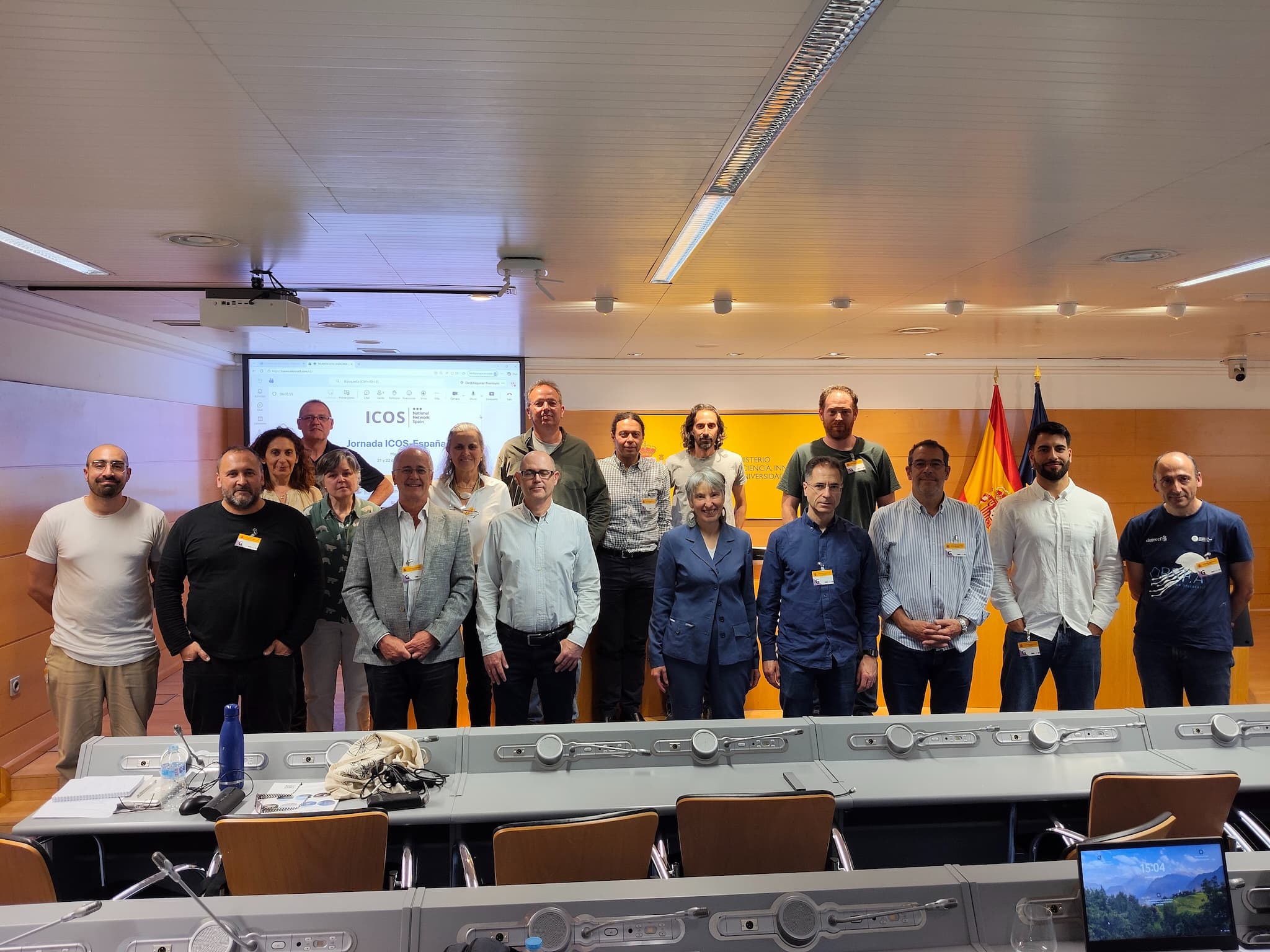
ICOS-Spain is built by a multidisciplinary community of scientists, technicians and institutions working together to deliver high-quality greenhouse gas observations across Spain and nearby ocean regions.
Explore the Spanish Network
Discover the stations that make up ICOS-Spain across the Atmosphere, Ocean and Ecosystem domains.
Access ICOS Data
Explore open greenhouse gas and carbon cycle data through the ICOS Carbon Portal.
View Real-Time Data
Follow recent visualisations from selected ICOS-Spain stations.
Contact the Network
Get in touch for collaboration, data access, institutional enquiries or general information.